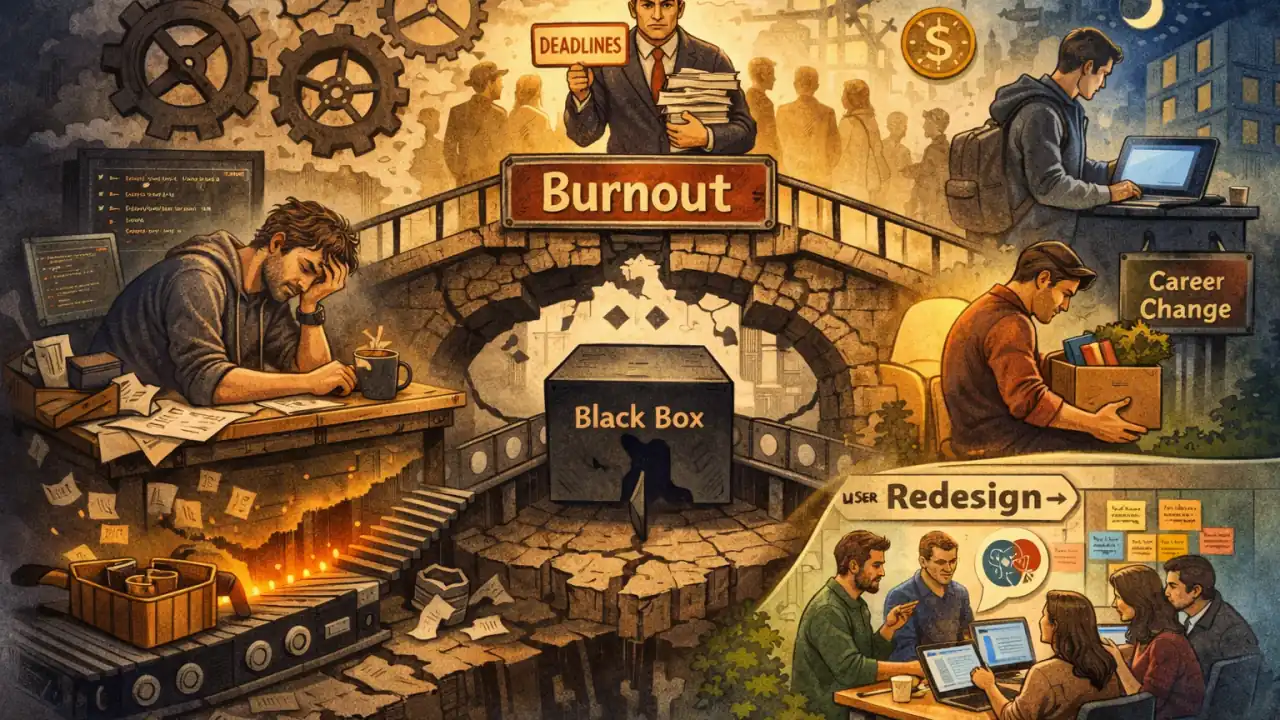
Nearly three out of four developers say they have experienced burnout at some point in their career.
That is not a statistic about fragile people. It is a signal about how we design work in tech.
After years of leading engineering teams and watching talented people quietly disengage, I have come to a simple conclusion: developer burnout is not a personal weakness problem. It is a system design problem. And until we treat it that way, we will keep losing our best engineers to exhaustion dressed up as "career changes."
This article unpacks why burnout shows up differently in software teams, what the data actually says, and — more importantly — what leaders can do about it.
What Burnout Actually Is (And Isn't)
The World Health Organization classifies burnout as an occupational phenomenon, not a personal disorder. That framing matters. It shifts the conversation from "who is struggling?" to "what is the environment producing?"
Three elements define it:
- Chronic exhaustion
- Growing cynicism or emotional distance from work
- A sense that your work no longer has impact
Burnout is not the tiredness that follows a hard launch. Rest fixes that. Burnout is the slow erosion that rest cannot touch — which is why "take a vacation" is one of the most misunderstood pieces of advice in our industry.
Why Burnout Hits Developers Harder
1. The Black Box Problem
Most developers never see the humans who use what they build. Requirements arrive as tickets. Completed work disappears into production. Feedback — if it comes at all — is filtered through layers of managers, analysts, and product owners.
When every feature is just another item on a backlog, and impact is invisible, even technically challenging work starts to feel pointless. Resilience depends on seeing that your work matters. Shipping into a void does the opposite.
2. Management Layers as a Stress Multiplier
In many organizations, managers position themselves as the single gateway between engineers and the rest of the world. This may simplify reporting, but it creates three compounding problems:
- Goals become fuzzy. Developers learn what to build but not why.
- Feedback skews negative. Failures travel fast; successes rarely do.
- Context becomes currency. When managers hoard context, career growth starts to feel like pleasing gatekeepers rather than creating value.
Low autonomy plus low visibility of impact is the exact configuration occupational research links to elevated burnout risk.
3. The "Coding Is Easy" Myth
"You just sit and type — how hard can it be?"
When non-technical leadership genuinely believes engineers are interchangeable, staffing decisions get made accordingly. Senior engineers end up compensating for churn instead of doing the deep work they are best at. For craftspeople, watching expertise get devalued is a direct route to cynicism.
4. High Salaries Don't Buy Immunity
There is a persistent narrative that well-paid developers should "complain less and enjoy the money." The research disagrees.
Once basic security is met, additional income quickly loses its power to compensate for missing autonomy, mastery, and purpose. Compensation softens stress. It does not prevent exhaustion or detachment.
What the Data Actually Says
JetBrains' 2023 DevEco report found that ~74% of developers have experienced burnout — and that those who have are more likely to actively monitor their mental health.
Read that again. Burnout is not hitting the unmotivated. It is hitting the conscientious — the people most invested in doing good work.
A few other findings worth sitting with:
- Developers who have burned out credit mental health, self-organization, and time management as the biggest levers for their productivity.
- Developers who have not burned out credit tooling, process, and IDE mastery as theirs.
- More than half of respondents said deeper knowledge of their IDE directly improves daily output.
The message is clear: productivity and well-being in engineering are not separate conversations. Teams that ignore one will eventually pay for it in the other.
Why Burnout in IT "Feels Different"
Cognitive Load You Can't See
Software development requires holding complex mental models in working memory — code structure, business rules, dependencies, edge cases — all simultaneously. Every interruption forces a rebuild.
The brutal part? That rebuild work is invisible. It never shows up in a Jira ticket or a velocity chart. Which is why engineers so often feel: "I was busy all day and accomplished nothing."
That is not weakness. That is a system producing invisible work.
Remote Work and the Disappearing Boundary
Remote and hybrid setups offer flexibility — but they also dissolve the line between work and life. Tickets before breakfast. Slack at 11 PM. "Real work" squeezed between back-to-back calls.
Post-pandemic studies show remote engineers often face more meetings, stronger surveillance, and less informal peer support — and then work outside hours to compensate. It is a pattern that quietly scales into chronic overwork.
Burning Out on Work You Love
This one is subtle. Engineers who love their product, team, or craft willingly push themselves for long stretches. Because the work feels meaningful, early warning signs — sleep debt, irritability, shrinking life outside work — are easy to dismiss.
Eventually, enthusiasm flips to numbness. Nothing "went wrong." The system just ran too hot for too long. This pattern is especially common in startups and games, where crunch gets dressed up as heroism.
What Leaders Can Actually Do
If burnout is a system problem, the fix is systemic. Here is where I would focus first.
1. Shorten the Distance Between Engineers and Impact
Involve developers in user interviews, discovery calls, and usability sessions. Share concrete stories of how releases affected real customers — not just ticket counts. Rotate engineers through support-adjacent roles, framed as learning, not punishment.
This single shift — replacing the black box with visible impact — is one of the highest-leverage things a leader can do.
2. Give Teams Real Autonomy (With Real Context)
Autonomy is not the absence of constraints. It is giving teams meaningful input into how problems get solved:
Explain the why behind features, not just the what. Let teams push back on deadlines with data, not deference. Agree on outcomes, then step out of the implementation.
Same workload. Radically different burnout risk.
3. Engineer the Work System, Not Just the Code
Apply engineering thinking upstream:
- Limit concurrent work to reduce context switching.
- Cluster meetings and protect shared focus blocks.
- Invest in tooling and CI — every manual pain point consumes cognitive capacity that should be going to hard problems.
Throughput and well-being rise together when the system is designed for sustainability instead of heroics.
4. Normalize Mental Health as Part of Professional Life
- Provide access to counseling and mental-health days without stigma.
- Train managers to recognize early burnout signals and respond by adjusting workload — not by questioning loyalty.
- Make "I am at capacity" an acceptable sentence at any level.
When mental health is openly supported, people ask for help before they crash. When it is not, they quit.
The Bottom Line
Developer burnout is not an unfortunate side effect of ambitious work. It is a predictable outcome of systems that combine high complexity, weak feedback loops, and cultural myths that trivialize cognitive demand.
The leaders who will build the strongest engineering organizations over the next decade are the ones who stop asking "how do we make people more resilient?" and start asking "what is our system doing to them?"
Burnout is not a signal that your people are broken.
It is a signal that your system needs a redesign.
If this resonated, I would love to hear from you: What is the single biggest burnout driver you have seen in engineering teams — and what actually worked to fix it? Drop your experience in the comments. The best ideas in this space almost always come from practitioners, not frameworks.