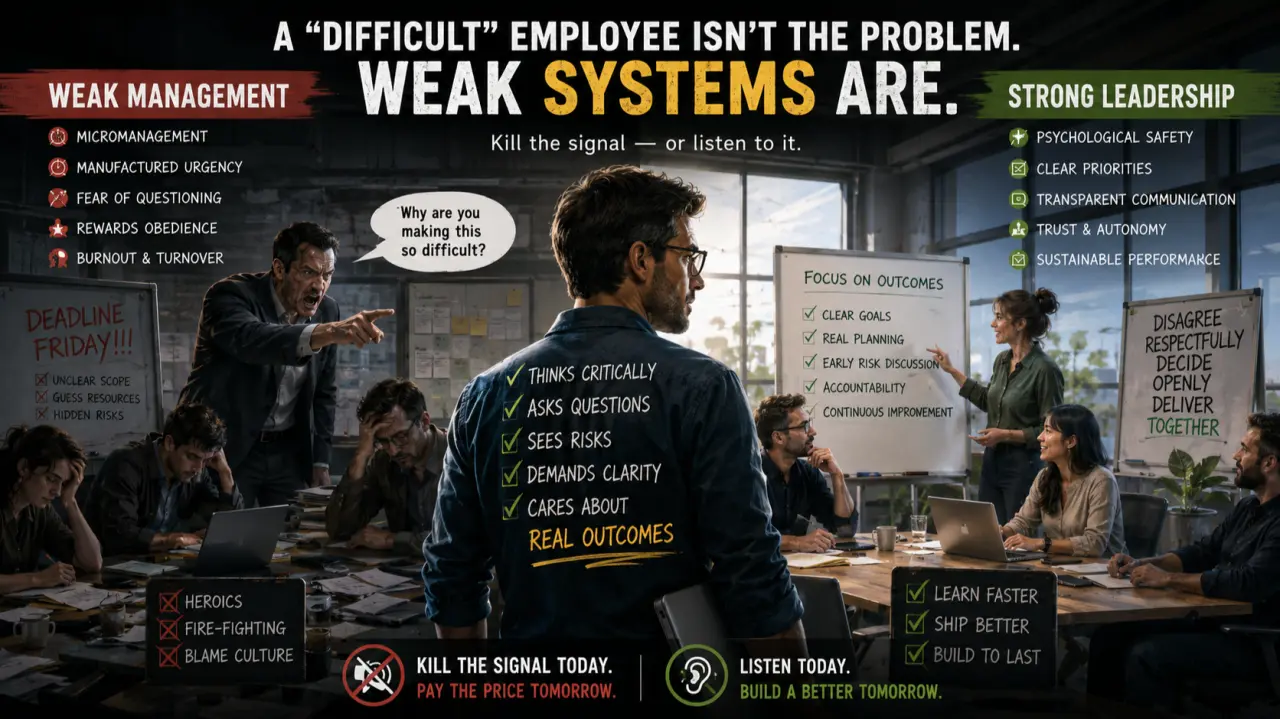
Every job posting says the same thing: we want self-starters, proactive people, critical thinkers, folks who take ownership. Then someone actually becomes that person — and turns into a problem. Not once in a while. Like clockwork. And the problem isn't them. It's the system.
Let me be clear up front: I'm not talking about combative people or weak performers. The opposite. The system grinds hardest against its best people — the ones who think for themselves, ask the uncomfortable questions, demand transparency, refuse to fake being busy, and call out management problems out loud. Let's break down why that happens — and what both sides should do about it.
Autonomy Is Always Inconvenient
Professional growth never looks convenient from the outside. People start setting boundaries. They stop hauling pointless overload. They ask about priorities. They demand clarity on deadlines and resources. They stop treating permanent crunch as normal. In engineering this shows up the sharpest — where there are estimates, deadlines, and risks.
In a lot of teams, delivery runs on personal heroics, year after year. Everything's on fire, all the time. Deadlines get set before anyone scopes the work. Resourcing is a guess. Risks get swept under the rug until they blow up in prod. And the engineer who calmly says, "we can't ship this by Friday without cutting corners we'll pay for later," instantly becomes "the difficult one." Even though they're the only person actually trying to head off the next incident.
Then the defense mechanism kicks in. In orgs it's called defensive routines: teams and individuals retreat into familiar reactions just to dodge discomfort — and that's exactly how they bury the real problems. The system isn't protecting effectiveness. It's protecting its own comfort zone. The more autonomous the engineer, the harder they push on that armor. And the harder the system pushes back.
Weak Management Runs on Pushovers
For an insecure manager, control is a way to calm themselves down — not a way to get work done. Hence the familiar playbook: be available 24/7, micromanagement, emotional pressure, manufactured urgency, a team that can't move without a nod from above. In that environment, the prized people are the ones who don't push back, agree fast, never ask why, and are always "saving the day." Convenient. Predictable. Easy on the boss's ego.
Except this model doesn't scale. On a small team, hands-on control still holds together. On a big one, it turns into burnout, fuzzy ownership, buried risks, and weak decisions. A strong specialist is inconvenient precisely because they break that setup: they demand transparency, real reasoning, actual planning, honest priorities, and accountability at every level — not just on their own shoulders. And the maturity that takes isn't on them anymore. It's on the whole system.
A resilient organization doesn't run on obedience. It runs on a balance of control and initiative. Tip the scale too far either way, and the system rots. So a strong employee isn't a threat. They're a signal. They show you exactly where the balance already broke.
Strong Leaders Build — They Don't Bully
Strong leaders don't hold control through pressure. They build processes so the system runs without hand-holding: so knowledge doesn't walk out the door with one person, and decisions don't bottleneck on a single approver. And they value the people who name problems out loud, argue on the merits, spot risks early, make their own calls, and don't paper over hard questions with fake calm.
That's what psychological safety actually is: you can disagree, ask questions, and screw up without fear of getting your head bitten off. Those teams learn faster and ship better — not in spite of the arguments, but because of them. Mature management gets one simple thing: "easy to manage" and "effective" are not the same word.
More than that: a too-comfortable team is itself a symptom of weak culture. In the moment, it looks like order. Down the road, it's near-guaranteed decay — for the management and the company alike.
What To Actually Do About It
Almost every company says it wants initiative and independence. Almost none is ready for the fallout. And that's not a question about the employee — it's about the management maturity of the org. Real talk: the problem isn't that someone is "too independent." The problem is that management is too weak to work with them without a stick.
Recognize your company? You're not alone — it's like this almost everywhere. But recognizing it changes nothing on its own. So here's the practical stuff, for both sides.
For Engineers
Don't confuse being combative with having principles. A professional disagreement is about facts, risks, and alternatives. Getting emotional and making it personal — that's what actually makes you the problem. Your power is in the argument, not the volume.
Put it in writing. Pushed to move a deadline, spotted a risk — write it down. Email, ticket, pull request, team chat. A verbal comment evaporates; a written one becomes a management signal nobody can "forget they heard." If it's not on the record, it doesn't exist as far as the system is concerned.
Pick your environment on purpose. If a company systematically punishes autonomy and rewards obedience — it's not you, it's the culture. Sometimes the only sane move is to leave. You can't fix a systemic problem with personal heroics. You don't carry that one solo.
Learn how management actually works. To tell weak management apart from your own mistakes, you need to understand how organizations are wired. Otherwise you'll keep taking every systemic problem personally.
For Managers
Separate convenient from effective. Take an honest look at what you actually reward. If the bonuses and the best projects keep going to the people who don't push back and carry everything themselves — that's not a lucky team, that's your systemic problem. Effectiveness is contribution and results, not busyness and obedience. Everything else is management cosplay.
Don't confuse control with caring about the outcome. Micromanagement treats your anxiety, not the quality of the work. If an engineer delivers consistently, how they get there is their call. Yours is to give them resources and shield them from overload.
Make uncomfortable questions normal. Build a format that critiques processes, not people: retros, blameless incident reviews, open conversations about risk. A team that can argue and screw up without fear of getting punished performs noticeably stronger. That's psychological safety in practice — not on a slide.
Stress-test yourself for scale. Imagine your team triples. Does your management model survive without you in the loop 24/7? If not — you're not building an organization, you're building codependency. Rigid hierarchies work beautifully right up until they collapse under their own weight.
Bottom Line
A "difficult" employee isn't a diagnosis of the person. It's a mirror weak management hates looking into. A strong specialist doesn't break the system — they're just the first to see it's already broken, and they say so out loud.
So the real question isn't how to make these people more convenient. It's what you'll do when you're standing in front of one: kill the signal — or listen to it. Killing it is cheaper today and the most expensive thing later. Listening is the exact maturity everyone demands in their job postings and almost nobody is willing to show themselves.
Hat tip to Dmitry Sozonov, whose article sparked this one — "Why a Good Employee Suddenly Becomes Inconvenient" (originally published in Russian on Habr). The core idea is his; the framing and translation are mine. Original: https://habr.com/ru/articles/1036746/