Since the start of 2026, articles about the collapse of SaaS valuations have been landing on my feed one after another. At first it looked like a one-off panic around a couple of tickers. Then it became clear this is the biggest repricing of the software market since the dot-com crash — just slower, and almost unnoticed.
The numbers
Let's start with the companies themselves, where the picture, across various roundups, looks like this:
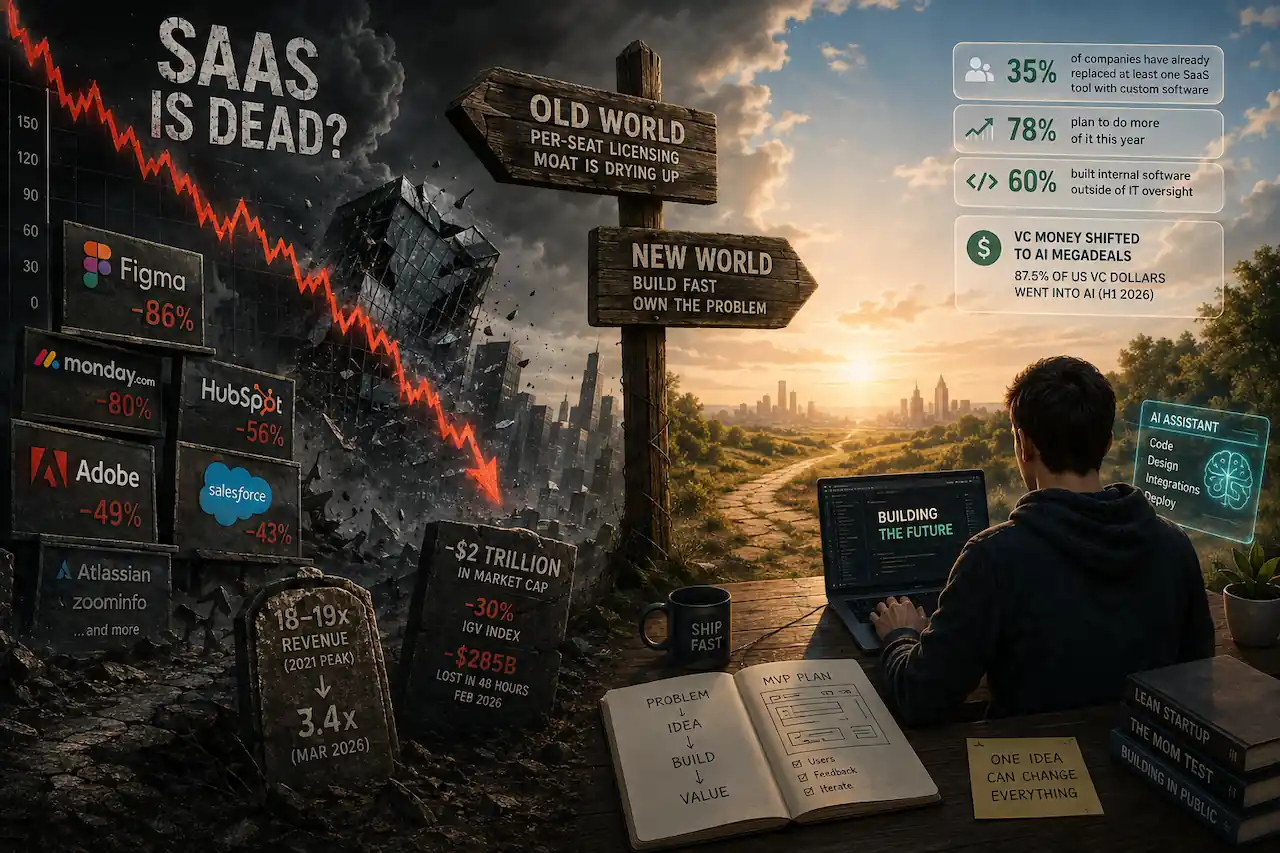
- Figma — down from its peaks by, depending on the estimate and the reference point, 50 to 85%. 24/7 Wall St put it at minus 86.5% from its high of $142.92 in April; by mid-year, per Motley Fool, the stock lost another 52% in the first half — after already bouncing off the bottom.
- monday.com — down 80% from its peak ($316.98), per the same 24/7 Wall St data.
- HubSpot — down 56% year-to-date through June, trading near its 52-week low (SaaStr).
- Adobe — down 49% over the past year as of August (CNBC), "cheaper on an earnings multiple than it's been in over a decade."
- Salesforce — down 43% year-to-date through June, having already fallen 32% before its Q1 earnings (SaaStr).
- Atlassian, ZoomInfo, and a good dozen other names from the software index are also deep in the red — in August, CNBC lists them right alongside Adobe and Salesforce as companies whose stocks are "crashing" (CNBC).
I'm deliberately not trying to force this into one neat table with a single reference date — the market is so jittery that the numbers from January, April, and August differ by tens of percentage points. But the direction is roughly the same across the board, and that matters more than any single percentage.
Across the market as a whole, the damage already runs into the trillions. The IGV software index (iShares Expanded Tech-Software ETF) has lost about 30% from its September 2025 peak (SaaStr; Tech Insider), and the combined market cap of public software, by several investment-bank estimates, has shed roughly $2 trillion. One of the triggers was panic over the idea that AI agents would make the classic per-seat licensing model obsolete — in a single episode in February 2026, the software market lost about $285 billion in market cap in 48 hours, a figure cited independently by both CNBC and industry breakdowns (CNBC; Tech Insider).
The multiple is where the scale of what's happening shows up best. Public SaaS companies were valued at 18–19x annual revenue at the 2021 peak. By March 2026, the median multiple had fallen to 3.4x (Aventis Advisors) — independent SEG data puts it at around 3.2x for the second quarter. That's a level the industry hasn't seen in more than ten years: in five years, the multiple collapsed roughly fivefold.
My personal favorite number: software now trades cheaper than the S&P 500 for the first time in history (SaaStr). Software used to command a multiple several times higher than the market — 70–80% margins, a subscription model, predictable revenue, the perfect asset for a premium multiple. Now it's cheaper than an index that includes oil companies and supermarkets running on single-digit margins. "Software eats the world" ended with the world suddenly refusing to pay a premium for the fact that it is software.
Why this is happening
The official version, repeated from article to article: SaaS growth is slowing, and corporate budgets are flowing toward AI providers — by some estimates, up to 70% of incremental IT spend now goes there. But the more interesting story isn't the macro explanation — it's the micro one, what's happening at the level of a specific product and a specific customer.
Companies have started vibe-coding their own software instead of buying someone else's. This is no longer a hypothesis — it's measurable now. In February 2026, Retool published a survey of 817 of its own customers and builders: 35% of companies have already replaced at least one SaaS tool with software they built themselves using AI, and 78% plan to do more of it over the coming year. On top of that, 60% of respondents admitted they'd built internal software outside of IT's oversight at least once in the past year (Retool / Businesswire). Retool's CEO, David Hsu, puts it bluntly: "SaaS products force you to work their way. Now that vibe coding's gone mainstream, businesses that can custom-build their value drivers will have a competitive edge."
The first to get hit were exactly the categories that were always the most boring, most legible slice of B2B SaaS: internal admin tools and workflows, followed by CRM, BI tools, project management, and support tools — precisely what Retool's report lists as the main areas of replacement. The same thing is being called out separately in martech, where vibe coding is already described outright as a threat to a whole class of niche tools (MarTech).
Investors read these signals not as a localized threat to a few niches, but as a threat to the per-seat licensing business model as a whole: if an AI agent does the work of several employees, and a team can put together its own internal tool over a weekend, why keep paying for a per-head subscription? That's exactly the "seat compression" — the shrinking number of paid seats — that SaaStr names as one of the key drivers behind the collapse in multiples (SaaStr).
So we're genuinely seeing the effect of vibe coding not in developer-productivity surveys, but right there in the money — in public company share prices and in reports on who replaced what internally.
Venture capital no longer works the old way for software startups
According to PitchBook and NVCA data, 87.5% of all US venture dollars in the first half of 2026 went into AI megadeals (Fortune). Corporate investors — Nvidia, the hyperscalers, the frontier labs themselves — accounted for a record 87.9% of the value of all AI deals, and these deals keep getting bigger and fewer: PitchBook describes the trend outright as "fewer deals, bigger bets," with a clear tilt toward later-stage megarounds (PitchBook).
In this picture, there's literally no room left for ordinary B2B SaaS on the classic pre-seed → seed → A → B → C → unicorn ladder. A telling detail from that same Fortune piece: on the secondary market, companies that last raised a round in 2021–2022 (i.e., the typical subscription-SaaS startups of the last cycle) are now trading at a 54–59% discount to their last valuation, while fresh AI startups trade at almost no discount at all. PitchBook analyst Emily Zheng puts it without mincing words: "Companies that cannot raise on strong terms right now generally are not raising at all."
In other words, venture capital hasn't "fallen out of love" with software as a category — it has almost entirely shifted toward infrastructure and frontier models, while classic applications and per-seat B2B SaaS have indeed been left to fend for themselves: no round, no 200-person headcount, but with AI tools that now cover what used to require an engineering department. And at the other end of the spectrum, stories keep piling up about solo founders and two- or three-person teams taking a SaaS product to meaningful revenue without a single venture dollar — enough such cases have accumulated in 2026 that this has stopped being an exception (Fortune on solo founders).
Software isn't dead — the moat dried up
This is worth pausing on, so as not to conflate two different things. One is the collapse in public-company valuations. The other is the state of the SaaS market itself. And here's the paradox: the market keeps growing even as its biggest players' stocks fall.
By analysts' calculations, the global SaaS market grew from $408 billion in 2025 to a projected $465 billion in 2026, and total company spending on SaaS subscriptions rose 8% year over year — while the average number of SaaS apps a company uses has barely budged (Zylo). Gartner separately forecasts that software spending will grow 15.2% year over year in 2026, remaining the fastest-growing category in the entire IT budget. People and companies are still paying for subscriptions just as they always were.
The result is a picture that looks strange at first glance: demand for software is growing while the value of the companies selling it is collapsing. The answer is that the market isn't repricing the need for software — it's repricing specific big players' ability to defend their share of it. The barrier to entry in B2B SaaS used to be high by definition: you needed a team of 50–200 people, a product-and-engineering pipeline, years to get a product to the point where enterprises would pay for it — and a funding round to finance all of that. That's exactly what built the moat around Salesforce, Atlassian, HubSpot, and dozens of smaller companies: not that no one else could think of their product, but that no one else could build it quickly and cheaply.
Vibe coding, and modern AI tooling in general, removes exactly that barrier — not the demand for the product itself. The moat is drying up, but the water (that is, the demand) hasn't gone anywhere. It's simply no longer a monopoly held by big SaaS companies — it's now available to a small team, or even to one person who, a few years ago, would never have thought of competing with a publicly traded, billion-dollar company.
What to do about it
If getting into the software business used to look like: "come up with an idea → find co-founders → raise a round → hire a team → ship an MVP two years later," the chain is radically shorter now. You still need to come up with the idea, but from there, a single person with AI tools can put together a working product in weeks instead of years — and without the funding round that used to be a mandatory part of the game.
This is genuinely the best news in a long time for people who couldn't previously afford the classic startup path — no money for a team, no connections to raise a round, no two spare years to build an MVP with investor backing. The moat around the SaaS market was never held up by brilliant product ideas — it was held up purely by the resources needed to execute them. The resource barrier has collapsed. Ideas haven't — those are still in short supply.
So there really is just one question: which idea to start with?
Sources
- SaaStr — The SaaS Rout of 2026 Is Even Worse Than You Think
- SaaStr — Salesforce at 3.1x ARR, HubSpot Down 56%, Adobe at 11x Earnings
- CNBC — 'SaaSpocalypse' debate intensifies as software stocks swing wildly
- 24/7 Wall St — The SaaS-Pocalypse's Biggest Losers: Figma, Duolingo, and Monday.com
- The Motley Fool — Why Figma Stock Lost 52% in the First Half of 2026
- Tech Insider — AI Agents Just Erased $2T in SaaS Value
- Aventis Advisors — SaaS Valuation Multiples: 2015–2026
- Array Capital — B2B SaaS valuation multiples: 2021 to 2026
- Retool 2026 Build vs. Buy Report (Businesswire)
- MarTech — Vibe coding is hollowing out the martech stack fast
- PitchBook — Q3 2026: Fewer Deals, Bigger Bets
- Fortune — 87.5% of venture dollars went to AI. The rest fought over scraps
- Fortune — Solo founders are using AI to do the work of entire teams
- Zylo — 70+ SaaS Statistics for 2026